Posts

Visitation

Image
  The King of Israel, the Lord, is in your midst, you have no further misfortune to fear. On that day, it shall be said to Jerusalem: Fear not, O Zion, be not discouraged! The Lord, your God, is in your midst, a mighty savior; He will rejoice over you with gladness, and renew you in his love, He will sing joyfully because of you, as one sings at festivals.   Zephaniah 3 With Our Blessed Lady, we too are tabernacles of the Most High God; the Lord is within us. As the Lord rejoices over us, singing joyfully because of our openness to him, we rejoice greatly with Our Lady for all that the Lord in his mercy has done for her, accomplished for all of us through her. The Visitation , c. 1495, attributed to Rueland Frueauf the Elder, German (c. 1445 - 1507), o il on panel,  27 5/8 x 14 15/16 in., Fogg Museum, Cambridge.

On Memorial Day

Image
The practice of decorating graves with flowers on specific days in spring is an ancient custom and may be the remote origin of what we celebrate now on the last Monday of May as “Memorial Day” in commemoration of those who have lost their lives serving their country. “Decoration Day” (as it was originally called) began in the bloody wake of the Civil War, when women, especially in the South, began tending to the graves of fallen soldiers, often regardless of which side they fought for. Their willingness to overlook past divisions was lauded in the North, and their kindness was viewed as an olive branch to many—exactly what we need in our polarized country today. In the Gospel this morning, Jesus tells his disciples that they will have trouble in the world, but to take courage and have peace in him . This always begins with humbly acknowledging our sins. Meditation by Father Dominic.

Seventh Sunday of Easter

Image
Over and over during these final days of Eastertide, we have been listening to excerpts from the Last Supper Discourse, about four chapters long in the second half of the Gospel of John; today’s Gospel is from the concluding section of the Discourse. And this morning we eavesdrop on the prayer of Jesus the Beloved Son to his Father. It’s as if we’ve barged in on Jesus in the midst of a very intimate conversation. But Jesus draws us into the very heart of his prayer to the Father. So I listen, but I lose my bearings. There is surely a beauty to the language but also a circularity. It’s just not a simple, linear narrative. I get confused, and I want to analyze. I want to say to Jesus, “Wait, wait. What do you mean?” But clearly, that’s the wrong question. Asking what it means would be beside the point. It would be like standing at the Grand Canyon and saying, “Wait I don’t get it, what does it mean?” Or like asking a person who is doing an unexpected kindness for you, “What exactly do ...

Ascension

Image
  How to explain the experience of Jesus after his resurrection? There is the drastic reality of his physical presence, wounds and all; he is disarmingly familiar, but there is also, mysteriously, something much more, what we might call a transformed physicality. He walks through a door, eats a piece of fish with his disciples then disappears; he suddenly shows up again wishes peace, then opens the wound in his side for Thomas to touch, and vanishes again. This coming and going happens over and over again and then   after forty days, these appearances no longer occur. At this juncture the Ascension describes the event of his exaltation and enthronement as Israel’s Messiah, seated at God’s right hand; he is at last victorious Lord of the world, and he commissions his followers to act on his behalf and inaugurate this new epoch of his reign. It seems a bit incongruous, but I keep thinking of a scene from a Neil Simon comedy. The actress Anne Bancroft is just ...

His Peace

Image
  As we approach the great feast of the Ascension, we hear the Lord Jesus assure us yet again today: My peace I give you . Without doubt, Christ gives us his peace, and joyfully so, for that is what he came to do; his Death and Resurrection are intended to bring us his peace, that is, the magnificent joy and serenity that come from his perfect harmony with the will of the Father. But will we truly be able to receive Christ’s peace as he gives it to us? Peace, after all, cannot be simply handed over like a peach or a book! God forces neither his peace nor his love on anyone; indeed, he cannot. By their nature, such gifts cannot be imposed, since their very existence depends on their receiver engaging in a free, interpersonal relationship with their Giver. The Lord’s peace is not something that falls upon us in our passivity like the rain, and suddenly we find ourselves wet. We have to cooperate in order to receive inwardly this gift of peace since nothing can enter the inner sanc...

Keeping His Word

Image
Jesus answered and said to him, "Whoever loves me will keep my word, and my Father will love him, and we will come to him and make our dwelling with him. 24 Whoever does not love me does not keep my words… In these opening two verses of today’s Gospel, Jesus distinguishes between two responses to him: those who love him and those who do not love him. Those who love him keep his word and those who do not love him do not keep his word. Of those who love him and keep his words, he says that his Father will love him and that he and the Father will come to him and make their dwelling with him. Of those who do not love him and do not keep his commandments he says nothing regarding their relationship to the Father and the Son; only that this word is not his but that of the Father who sent him.  These are solemn words of the Lord; they are a matter of eternal life. Jesus has set the weight of the Trinity behind them. They seem to divide people into two classes. It is true that there a...

Pruning

Image
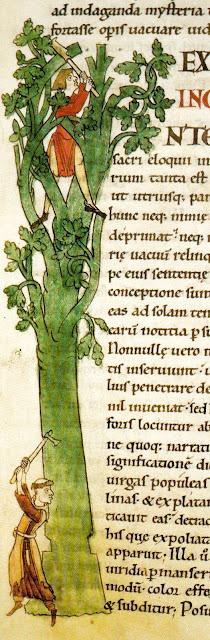
  From Jesus’ parable of the Vine and the Branches, one thing should remain very clear: the Father as Vinedresser sooner or later is going to cut into all the branches—the withered ones to cut them away and burn them, the fertile ones to prune them so that they bear still more fruit. In other words, none of us, Jesus’ disciples, is going to escape this necessary and often painful process of purification in view of a more abundant harvest. True love always bears fruit because love is for giving away, and true love is the only thing God ultimately cares about. I don’t suppose it feels very good to be a branch and to be cut into, for whatever purpose! And yet God’s love for us must often take precisely this form, performing on us a painful operation in order to heal, purify and sanctify us, so that through us the fruits of God’s love may then be borne into our hungry world. We are sentient, soul-endowed branches on Christ the Vine. As such we are not fated to be either ster...