Posts

Showing posts from August, 2023

Cistercian Wisdom

Image
The love of God is born in us by grace, fed with the milk of reading, nourished with the food of meditation, strengthened and enlightened by prayer. You have one cell outwardly, another within you. The outward cell is the house in which your soul dwells together with your body; the inner cell is your conscience and in that it is God who should dwell with your spirit, he who is more interior to you than all else that is within you. The door of the outward enclosure is a sign of the guarded door within you, so that as the bodily senses are prevented from wandering abroad by the outward enclosure, so the inner senses are kept always within their own domain. THE GOLDEN EPISTLE, ST. WILLIAM OF THIERRY

Beheading of John the Baptist

Image
The purported head of   Saint John the Baptist ,  enshrined in its own Roman side chapel in the   San Silvestro in Capite ,   Rome According to the   synoptic Gospels, Herod, who was   tetrarch, or sub-king, of   Galilee   under the Roman Empire, had imprisoned John the Baptist because he reproved Herod for divorcing his wife and unlawfully taking   Herodias, the wife of his brother   Herod Philip I. On Herod's birthday, Herodias' daughter (whom   Josephus   identifies as   Salome) danced before the king and his guests. Her dancing pleased Herod so much that in his drunkenness he promised to give her anything she desired, up to half of his kingdom. When Salome asked her mother what she should request, she was told to ask for the head of John the Baptist on a platter. Although Herod was appalled by the request, he reluctantly agreed and had John executed by beheading in the prison. Jewish historian   Josephus   al...

Saint Augustine of Hippo

Image
Today, August 28, the Church honors St. Augustine. St. Augustine was born at the town of Thagaste (now Souk-Ahras in modern day Algeria) on November 13, 354 and grew to become one the most significant and influential thinkers in the history of the Catholic Church. His teachings were the foundation of Christian doctrine for a millennium. The story of his life, up until his conversion, is written in the autobiographical Confessions, the most intimate and well-known glimpse into an individual's soul ever written, as well as a fascinating philosophical, theological, mystical, poetic and literary work. Augustine, though being brought up in early childhood as a Christian, lived a dissolute life of revelry and sin, and soon drifted away from the Church - thinking that he wasn't necessarily leaving Christ, of whose name he acknowledges "I kept it in the recesses of my heart; and all that presented itself to me without that Divine name, though it might be elegant, well written, and...

Humility

“The greatest among you must be your servant. Whoever exalts himself will be humbled; but whoever humbles himself will be exalted.”   Matthew 23:11–12 If you were to plan out the ideal future for yourself, what would it look like? Imagine if you were not constrained by budget or resources. Imagine if you could pick to do anything you wanted, to go anywhere you wanted, and enjoy any activity that you wanted. Imagine the greatest experience you could possibly have. What would that be? Most people would immediately think about indulging in the greatest pleasures imaginable. A life of the most luxurious accommodations, the best food, the most beautiful scenery and the most relaxing and enjoyable time possible. But would that truly be the “ideal future for yourself?” The Gospel passage above is very clear. Greatness is found in servanthood. Exaltation is enjoyed only through humility. Is the ideal lifestyle one that is filled with indulgence, entertainment, luxury, and the like? Certain...

Feast of Saint Bartholomew

Image
Philip found Nathanael and told him, “We have found the one about whom Moses wrote in the law, and also the prophets, Jesus son of Joseph, from Nazareth.” But Nathanael said to him, “Can anything good come from Nazareth?” Philip said to him, “Come and see.”   John 1:45–46 Nathanael, who also goes by the name Bartholomew, reacted strongly to the news from his friend Philip that they had found the promised Messiah. Why did Nathanael react this way? Most likely because it was common knowledge among the Jews that the promised Messiah would come from Bethlehem, not from Nazareth. So Nathanael immediately raises this doubt because of Jesus’ supposed origin. Of course, Jesus actually was born in Bethlehem and only later moved to Nazareth, but Nathanael did not immediately realize this. The first lesson to ponder is that, just like Nathanael, we can easily doubt matters of faith because we do not fully understand. Perhaps if Philip had come and said that Jesus was born in Bethlehem but rai...

The Queenship of Mary

Image
The twentieth century saw a great resurgence in devotion to the Mother of God. Several decades prior to that century, on December 8, 1854, Pope Pius IX declared the Dogma of the Immaculate Conception. Four years later, the Blessed Mother appeared to Bernadette Soubirous, a fourteen-year-old peasant girl, in Lourdes, France. In this apparition, when Bernadette asked who the Heavenly Lady was, she responded, “I am the Immaculate Conception.” This mystical confirmation of the papal dogma sparked great devotion to the Mother of God, and Lourdes became a frequent pilgrim site where many miracles have taken place. In 1916, three shepherd children in Fátima, Portugal received three apparitions from the Angel of Peace, the Guardian Angel of Portugal. Then, in 1917 they received six apparitions from the Lady of the Rosary, as she called herself. On the day of her final apparition, some 70,000 had gathered and all witnessed the promised miracle. A pouring rain immediately stopped, the sun danced...

Pope Saint Pius X

Image
Pope Pius X, born Giuseppe Melchiorre Sarto, was the first Pope elected in the 20th century. He came to the papal office in 1903 and died 11 years later in 1914, just as World War I was beginning. He was born in 1835 at Riese, near Venice, and was one of eight children. His family was poor. He felt a calling to be a priest at a young age and was ordained in 1858. After 26 years, he was named bishop of Mantua, Italy, and in 1893, he became patriarch of Venice.   As Pope, he issued decrees making the age of First Holy Communion earlier (at the age of 7) and advocated frequent and even daily reception of the Eucharist. He promoted the reading of the Bible among laypeople, reformed the liturgy, promoted clear and simple homilies, and brought back Gregorian chant. He revised the Breviary, reorganized the curia, and initiated the codification of canon law. Like his predecessors, he promoted   Thomism   as the principal philosophical method to be taught in Catholic institutions....

Saint Bernard of Clairvaux

Image
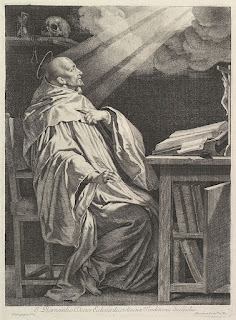
  Bernard was born into a high-nobility family in Fontaines, France. He was the third of seven children, with five brothers and one sister. As a member of a wealthy family with high social status, Bernard likely received a comprehensive education. His devout parents instilled in him a deep faith. At a young age, he was sent to be educated by the canons of the Church of Saint-Vorles at Châtillon-sur-Seine, located about eighty miles north of his hometown. There, he studied grammar, poetry, literature, rhetoric, dialectics, Scripture, and theology. He excelled in the study of Scripture, personalizing it through prayer. He also held a profound devotion to the Blessed Virgin Mary, continually seeking her intercession. When Bernard was around nineteen years old, his mother passed away. This event profoundly affected him and his entire family. He had already begun contemplating religious life, and his mother’s loss might have sparked a deeper resolve to abandon worldly pursuits and live ...

Blessed Guerric of Igny

Image
Blessed Guerric (c. 1070/80–1157) was abbot of Igny near Rheims, France, for nineteen years from 1138 till 1157.  He died at age 79 or even 89 if the earliest date of his birth is accepted; however the later date, 1180, is more likely.  The chronology is far from firm.  Guerric became abbot at around 60 years of age, when his health had begun to decline.  He was too ill to follow the common life, especially the manual labor.  Guerric came from Tournai, Belgium near the border of France, and received an excellent education in his native city.  After studies, he preferred to continue his prayerful and studious life by living as a hermit near a church in Tournai (before the construction of the cathedral that is now a World Heritage Site).  His attraction for solitude may have always remained close to Guerric’s heart, even though he chose cenobitic life at Clairvaux under St. Bernard.  Bernard, in letters from around 1125, refers to Guerric as a novic...

Wisdom of Saint Bernard of Clairvaux

Image
“A saint is not someone who never sins, but one who sins less and less frequently and gets up more and more quickly.” “If you concentrate hard on the state you are in, it would be suprising if you have time for anything else.” “What we love we shall grow to resemble.” “Many often err and accomplish little or nothing because they try to become learned rather than to live well.”   “To have a restful or peaceful life in God is good; to bear a life of pain in patience is better; but to have peace in the midst of pain is the best of all.”  

Assumption of the Blessed Virgin Mary

Image
“Mary’s Assumption is an event that concerns us precisely because every human being is destined to die. But death is not the last word. Death – the mystery of the Virgin’s Assumption assures us – is the passage to life, the encounter with Love. It is the passage to the eternal happiness in store for those who toil for truth and justice and do their utmost to follow Christ.” Pope Saint John Paul II “ Precisely because Mary is with God and in God, she is very close to each one of us. While she lived on the earth she could only be close to a few people. Being in God, who is actually within all of us, Mary shares in this closeness of God. She knows our hearts, can hear our prayers, can help us with her motherly kindness. She always listens to us, and, being Mother of the Son, participates in the power of the Son and in his goodness. We can always entrust the whole of our lives to this Mother. ” Pope Benedict XVI “ That transformation of our mate...

Saint Maximilian Kolbe, Franciscan Priest and Martyr

Image
Saint Maximilian Maria Kolbe was  born January 8, 1894 in ZduÅ„ska Wola, near Lodz in the  Russian Empire,   now part of Poland. His life climaxed in 1941 in Auschwitz, where he volunteered to die in place of a fellow prisoner he hardly knew.  On October 17, 1971, Kolbe was beatified by Pope   Paul VI , the first Nazi victim to be proclaimed blessed by the   Roman Catholic Church . In 1982 Pope   John Paul II  canonized   him, proclaiming also that he was to be   venerated   as a   martyr . Famous quotes by Saint Maximilian: Prayer is powerful beyond limits when we turn to the Immaculata  who is queen even of God's heart. If anyone does not wish to have Mary Immaculate for his Mother, he will not have Christ for his Brother. The conflict with Hell cannot be maintained by men, even the most clever. The Immaculata alone has from God the promise of victory over Satan.

The Four Marian Dogmas

Image
  Herman Richir (1866-1942), “La Madone” | Public Domain There are four dogmas stating Mary's personal relationship with God and her role in human salvation . 1) Divine Motherhood Mary's divine motherhood was proclaimed at the Council of Ephesus in  431. Various names are used to describe Mary's role as mother of Jesus. She is called "Mother of God" which translates the more accurately stated greek term "Theotokos" or "Birthgiver of God." The Council of Ephesus (431) attributed to Mary the title, Mother of God. This needs to be read against the Council's declaration that in Christ there are two natures, one divine and one human, but only one person. Indeed, according to the Council the holy virgin is the Mother of God since she begot according to the flesh the Word of God made flesh. This decision was further explained  by the Council of Chalcedon (451) which says with regard to Mary's divine motherhood: "...begotten from the Fathe...

Saint Lawrence

Image
St. Lawrence is thought to have been born on 31 December AD 225,   in   Huesca   (or less probably, in   Valencia), the town from which his parents came in the later region of   Aragon   that was then part of the   Roman province   of   Hispania Tarraconensis.   The martyrs Orentius and Patientia are traditionally held to have been his parents. Lawrence encountered the future   Pope Sixtus II, a famous teacher born in Greece, in Caesaraugusta (Zaragoza), and they travelled together from   Spain   to   Rome. When Sixtus became the   Pope   in 257, he ordained the young Lawrence who was only 22, as a   deacon, and later appointed him as "archdeacon   of Rome", the first among the seven deacons who served in the   cathedral church. This was a position of great trust that included the care of the treasury and riches of the Church and the distribution of alms to the indigent. St. Cyprian, ...
Image
Saint Teresa Benedicta of the Cross (Edith Stein)Virgin and   Martyr   Edith Stein, born in 1891 in Breslau, Poland, was the youngest child of a large   Jewish   family. She was an outstanding student and was well versed in   philosophy   with a particular interest in phenomenology. Eventually she became interested in the   Catholic   Faith, and in 1922, she was baptized at the   Cathedral   Church in Cologne, Germany. Eleven years later Edith entered the   Cologne   Carmel. Because of the ramifications of politics in Germany, Edith, whose name in   religion   was Teresa Benedicta of the Cross, was sent to the   Carmel   at Echt, Holland. When the Nazis conquered Holland, Teresa was arrested, and, with her sister Rose, was sent to the concentration camp at Auschwitz. Teresa died in the gas chambers of Auschwitz in 1942 at the age of fifty-one. In 1987, she was   beatified   in the large outdoor soc...

Saint Dominic Guzman

Image
On Aug. 8, the Catholic Church celebrates the feast day of St. Dominic Guzman, who helped the cause of orthodoxy in the medieval Church by founding the Order of Preachers, also known as Dominicans. “This great saint reminds us that in the heart of the Church a missionary fire must always burn,” Pope Benedict XVI said in a February 2010 General Audience talk on the life of St. Dominic. In his life, the Pope said, “the search for God’s glory and the salvation of souls” went “hand in hand.” Born in Caleruega, Spain around the year 1170, Dominic was the son of Felix Guzman and Joanna of Aza, members of the nobility. His mother would eventually be beatified by the Church, as would his brother Manes who became a Dominican. The family’s oldest son Antonio also became a priest. Dominic received his early education from his uncle, who was a priest, before entering the University of Palencia where he studied for ten years. In one notable incident from this period, he sold his entire collection o...

Feast of the Transfiguration Homily

Image
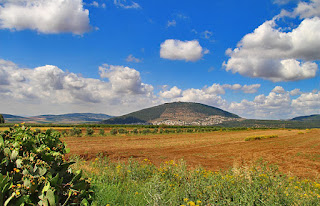
Today's Feast of the Transfiguration of the Lord takes precedence over the normal Sunday liturgy—it being a feast of the Lord Jesus Christ. Each of the three synoptic Gospels—Matthew, Mark and Luke—contain an account of the Transfuguration; we heard Matthew's this morning. I believe it was St. Augustine who first analyzed Matthew's gospel using the mountains that loom large in the narrative: first, the mountain of the Beatitudes with its sublime spiritual and ethical teaching contained in Jesus' Sermon on the Mount, second, the mountain of the Transfirguration (generally thought to be Mt. Tabor), and, third, the mountain or hill of Calvary. Each mountain can be thought of as representing an important aspect of the Gospel of Christ, and every aspect of Gospel life is mystical. Without Christ we can do nothing, but through, with and in Christ we can do all things. Thus, the ethical teaching of the Sermon on the Mount can only be truly practiced by people who live f...

Dedication of Saint Mary Major Basilica – Aug. 5

Image
First raised at the order of Pope Liberius in the mid-fourth century, the Liberian basilica was rebuilt by Pope Sixtus III shortly after the Council of Ephesus affirmed Mary’s title as Mother of God in 431. Rededicated at that time to the Mother of God, St. Mary Major is the largest church in the world honoring God through Mary. Standing atop one of Rome’s seven hills, the Esquiline, it has survived many restorations without losing its character as an early Roman basilica. Its interior retains three naves divided by colonnades in the style of Constantine’s era. Fifth-century mosaics on its walls testify to its antiquity. St. Mary Major is one of the four Roman basilicas known as patriarchal churches in memory of the first centers of the Church. St. John Lateran represents Rome, the See of Peter; St. Paul Outside the Walls, the See of Alexandria, allegedly the see presided over by Mark; St. Peter’s, the See of Constantinople; and St. Mary’s, the See of Antioch, where Mary is suppose...

Monastic Wisdom

Image
Moreover, if you more closely contemplate every creature, from the first to the last, from the highest to the lowest, from the loftiest angel to the lowliest worm, you will surely discover divine goodness—which we have called nothing other than divine charity—which contains, enfolds and penetrates all things, not by pouring into a place, or being diffused in space, or by nimbly moving about, but by the steady, mysterious and self-contained simplicity of its substantial presence. Charity joins the lowest to the highest, binds in harmonious peace contraries to contraries, cold to hot, wet to dry, smooth to rough, hard to soft, so that among all creatures there can be nothing adverse, nothing contradictory, nothing unbecoming, nothing disturbing, nothing to disfigure the beauty of the universe, but that all things should rest, as it were, in utterly tranquil peace, with the tranquility of that order which charity ordained in the universe. From  Mirror of Charity , Aelred of Rievaulx

Daily Reflection

Image
Abba Macarius said, "If slander has become to you the same as praise, poverty as riches, deprivation as abundance, you will not die. Indeed it is impossible for anyone who firmly believes, who labors with devotion, to fall into the impurity of the passions and be led astray by the demons."  In the monastery our daily prayers open with "Oh God, come to my assistance. Oh Lord, make haste to help me." Without God, we are powerless and our words and prayer are empty.